Showing posts with label Gregor Tarjan. Show all posts

October 1, 2009

CATAMARANS - TOMORROW'S SUPERYACHTS BOOK IS OUT


It is out, the book written by Gregor Tarjan about luxury catamarans is out. I am really looking forward to receiving it since I have spend quite a lot of time on it (less than Gregor), mainly listing all the catamarans available, interviewing designers and gathering pictures. We started with the project just before the Paris boat show last year when I met with Gregor to help him promote the great looking Aeroyacht 110. Less than a year after the project is alive. You can order the book from the publisher . I hope it will be a success like Gregor first book.
Thanks to all the people who have answered to my requests and interviews.


July 17, 2009

AMERICA'S CUP DESIGNS PROVE THE AEROYACHT® 110 IS AHEAD OF THE CURVE

The hull shapes of the America’s cup challenger BMW ORACLE Racing and defender ALINGHI didn’t go unnoticed and will make a lot of ink flow. Both are using wave piercing bows.


The radical Aeroyacht 110 catamaran designed by Gregor Tarjan and engineered by Morrelli & Melvin had, since the beginning - reverse bows. Pete Melvin, from Morrelli and Melvin, who took part in designing BMW ORACLE, and Gregor Tarjan founder of Aeroyacht International, tell us why?Morrelli and Melvin 60 ' Mala Conducta - Photo Credit Billy Black


Gregor Tarjan: “Reverse bows make the water think the boat is longer. A regular shaped bow will make the boat hobby-horse because as the boat is dipping into the sea the shape of the stem will force it back up quicker than if the stern is allowed to pass deeper and more gentler into the wave resulting in more comfort, safety and yes wetter. I think reverse bows are the future for small racing boats (where a wet ride is secondary) and large yachts over 60 foot.” Of course the potential clients for a luxury super catamaran like the Aeroyacht 110 will be interested in performance but this single argument might not be enough to convince him to go for reverse bows. That is what Gregor Tarjan and Pete Melvin both answer when a potential client asks them why his yacht should feature a wave piercing shape.

F 18 - Photo Crédit Pierrick Contin

Pete Melvin “To make it short and simple, wave piercing reduce pitching motions and hull resistance though waves. Pitching results in motion discomfort for passengers, increases hull resistance and reduces sail efficiency. We’ve been designing wave-piercing bows for quite a few years now both for racing and for cruising multihulls. It is quite interesting to see that Alinghi have developed a hull and bow shape quite similar to the A3 A-Class catamaran we developed in 2003. There were other wave-piercers prior to the A3 but the A3 has a very unique shape that has been emulated many times since then. We are involved with the BMW ORACLE team and had some input into their news floats shapes as well. Lots of R&D went into confirming what we already knew was a fast wave-piercing hull form. The shape of the bow and underbody of a wave-piercing hull is dependent on many variables so the best solution for one design may not look the same as another design. In fact, the F-18 cat is actually closer to the design requirements for a high performance cruising catamaran like the Aeroyacht 110.”


Gregor Tarjan and Pete Melvin have put all their experience, knowledge and energy to design the Aeroyacht 110, the most advanced cruising catamaran every created so far.

July 3, 2009

AEROYACHT 110 - The World most innovative super catamaran

Multihull passionate and expert Gregor Tarjan, founder of Aeroyacht International, and renowned designer Pete Melvin sat down together to think about what their dream luxury catamaran would be. They came out with many innovative solutions, some of them never seen on a multihull of that size.


In a previous post, I introduced a list of these innovations, like the Icon A5 amphibian plane “tender”, the reverse bows, the competition wing-rig, the semi-flybrigde... Let’s complete the list to show how well the Aeroyacht 110 concept was thought out.

A “Outside-In” design process. Most of the time yachts are designed the other way around. Large multihulls are loaded with equipment, staterooms and end up with two or three decks. Gregor says: "We first have conceptualized a pure sailing machine with a beautiful streamlined shape and then estimated the weight for a high-end, open plan luxury interior. Instead of fitting 6 small staterooms we prefer to offer our clients three large VIP suites in a fast sailing machine"

“Soft-chine” hulls. Multiple Chines hull can be seen on racing sailboats, fast motor yachts and tenders. They increase the yacht structure stiffness, stability, performance thanks to less wetted surface, and improve esthetics. On the top of that Morrelli and Melvin have applied all their knowledge in fast hulls and bows out of the water design. The entire forward section of the Aeroyacht 110 hulls are forced up and will come out of the water keeping resistance to a minimum and increasing surfing capabilities

Asymmetric dagger boards. They are seen on smaller size catamarans but never before on a 110 footer. Retractable dagger boards increase windward performance and safety at sea. In the downward position, they enable the Aeroyacht 110 to sail close to the wind. In the upward position, the boat experiences less resistance and really "flies". The asymmetric boards also prevent the Aeroyacht 110 from tripping over the waves since the yacht offer no resistance and can slide sideways. They are also a great feature to reduce the draft and access really beautiful and private anchorages.

Aeronautical engineering.
The design team in charge of the Aeroyacht 110 at Morrelli & Melvin is made up of aeronautical engineers and structural designers. They have made the most out of the same tools used to develop aircrafts structures like complex computers programs that model Computational Fluid Dynamics (CFD) and Finite Elements Method (FEM). They succeeded in keeping the structure as light as possible, yet strong enough to face the roughest sailing conditions.
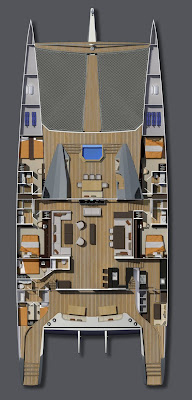
All this innovations were aimed at creating a super catamaran with a speed potential of over 32 knots and effortless cruising at 20 knots, in supreme yacht comfort and safety.